SendGrid
SendGrid to usługa w chmurze do dostarczania wiadomości transakcyjnych i marketingowych. Połączenie tej integracji pozwala aplikacji wysyłać e‑maile programowo (np. powitalne, reset hasła lub powiadomienia).
Kroki konfiguracji
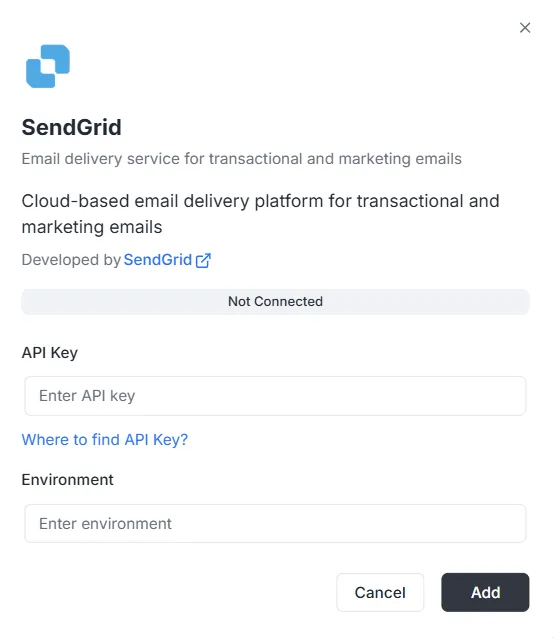
Dział zatytułowany „Kroki konfiguracji”Po wybraniu SendGrid z listy integracji pojawi się modal konfiguracji. Musisz podać następujące dane uwierzytelniające, aby nawiązać połączenie:
1. Klucz API
Dział zatytułowany „1. Klucz API”To token uwierzytelniający wygenerowany w koncie SendGrid.
- Pole: Wklej prywatny klucz API SendGrid w pole tekstowe.
- Pomoc: Jeśli go nie masz, kliknij link „Where to find API Key?” w modalu, aby zobaczyć instrukcję generowania.
2. Środowisko
Dział zatytułowany „2. Środowisko”Określ kontekst środowiska dla tej integracji.
- Pole: Wpisz identyfikator środowiska (np.
Production,Staginglub konkretną etykietę konfiguracji) w polu Environment.
Finalizacja połączenia
Dział zatytułowany „Finalizacja połączenia”Gdy pola są uzupełnione:
- Sprawdź pasek statusu (obecnie Not Connected).
- Kliknij czarny przycisk Add w prawym dolnym rogu, aby zapisać dane i aktywować integrację.
Dokumentacja API integracji SendGrid
Dział zatytułowany „Dokumentacja API integracji SendGrid”Konfiguracja SendGrid {#sendgrid-configuration}
Dział zatytułowany „Konfiguracja SendGrid {#sendgrid-configuration}”Konfiguracja klucza API SendGrid {#sendgrid-configure-api-key}
Dział zatytułowany „Konfiguracja klucza API SendGrid {#sendgrid-configure-api-key}”Konfiguruje klucz API SendGrid dla konkretnego projektu i środowiska.
Mutacja:
mutation { sendgrid_configureSendGrid ( apiKey: "SG._api_key_here" )}Wysyłanie wiadomości e‑mail {#sending-emails}
Dział zatytułowany „Wysyłanie wiadomości e‑mail {#sending-emails}”Wyślij prosty e‑mail {#send-simple-email}
Dział zatytułowany „Wyślij prosty e‑mail {#send-simple-email}”Wysyła wiadomość do jednego lub wielu odbiorców.
Mutacja:
mutation sendgrid_sendEmail { sendgrid_sendEmail ( email: { from: { email: "sender@archie.com", name: "Sender Name" }, subject: "Test Email", to: { email: "recipient@gmail.com", name: "Recipient Name" }, content: { type: "text/html", value: "<h1>Hello World</h1><p>This is a test email.</p>" } } ) { messageId success }}Odpowiedź:
{ "data": { "sendgrid_sendEmail": { "messageId": "sent-1234567890", "success": true } }}E‑mail z DW i UDW {#send-email-with-cc-and-bcc}
Dział zatytułowany „E‑mail z DW i UDW {#send-email-with-cc-and-bcc}”Mutacja:
mutation sendgrid_sendEmail { sendgrid_sendEmail ( email: { from: { email: "sender@example.com" name: "Sender Name" } to: [ { email: "recipient@example.com" name: "Recipient Name" } ] cc: [ { email: "cc@example.com" name: "CC Recipient" } ] bcc: [ { email: "bcc@example.com" } ] subject: "Email with CC and BCC" content: [ { type: "text/html" value: "<h1>Hello</h1><p>This email has CC and BCC recipients.</p>" } ] } ) { messageId success }}E‑mail z załącznikami {#send-email-with-attachments}
Dział zatytułowany „E‑mail z załącznikami {#send-email-with-attachments}”Mutacja:
mutation sendgrid_sendEmail { sendgrid_sendEmail( email: { from: { email: "sender@example.com" name: "Sender Name" } to: [ { email: "recipient@example.com" name: "Recipient Name" } ] subject: "Email with Attachment" content: [ { type: "text/html" value: "<h1>Hello</h1><p>Please find attached file.</p>" } ] attachments: [ { content: "SGVsbG8gV29ybGQ=" type: "text/plain" filename: "document.txt" disposition: "attachment" } ] } ) { messageId success }}Uwaga: Pole content w załącznikach musi być zakodowane w Base64.
E‑mail z kategoriami i tagami {#send-email-with-categories-and-tags}
Dział zatytułowany „E‑mail z kategoriami i tagami {#send-email-with-categories-and-tags}”Mutacja:
mutation sendgrid_sendEmail { sendgrid_sendEmail( email: { from: { email: "sender@example.com" name: "Sender Name" } to: [ { email: "recipient@example.com" name: "Recipient Name" } ] subject: "Categorized Email" content: [ { type: "text/html" value: "<h1>Hello</h1>" } ] categories: ["transactional", "notification"] tags: ["important", "urgent"] } ) { messageId success }}Zaplanowany e‑mail {#send-email-programmed}
Dział zatytułowany „Zaplanowany e‑mail {#send-email-programmed}”Mutacja:
mutation sendgrid_sendEmail { sendgrid_sendEmail( email: { from: { email: "sender@example.com" name: "Sender Name" } to: [ { email: "recipient@example.com" name: "Recipient Name" } ] subject: "Scheduled Email" content: [ { type: "text/html" value: "<h1>Hello</h1>" } ] sendAt: "2025-12-25T10:00:00Z" } ) { messageId success }}E‑mail z niestandardowymi argumentami {#send-email-with-custom-args}
Dział zatytułowany „E‑mail z niestandardowymi argumentami {#send-email-with-custom-args}”Mutacja:
mutation sendgrid_sendEmail { sendgrid_sendEmail( email: { from: { email: "sender@example.com" name: "Sender Name" } to: [ { email: "recipient@example.com" name: "Recipient Name" } ] subject: "Email with Custom Args" content: [ { type: "text/html" value: "<h1>Hello</h1>" } ] customArgs: { orderId: "12345" userId: "67890" campaignId: "abc123" } } ) { messageId success }}Wysyłka masowa {#send-bulk-emails}
Dział zatytułowany „Wysyłka masowa {#send-bulk-emails}”Wyślij wiele wiadomości {#send-multiple-emails}
Dział zatytułowany „Wyślij wiele wiadomości {#send-multiple-emails}”Mutacja:
mutation sendgrid_sendBulkEmail { sendgrid_sendBulkEmail( emails: { emails: [ { from: { email: "sender@example.com" name: "Sender Name" } to: [ { email: "recipient1@example.com" name: "Recipient 1" } ] subject: "Bulk Email 1" content: [ { type: "text/html" value: "<h1>Email 1</h1>" } ] } { from: { email: "sender@example.com" name: "Sender Name" } to: [ { email: "recipient2@example.com" name: "Recipient 2" } ] subject: "Bulk Email 2" content: [ { type: "text/html" value: "<h1>Email 2</h1>" } ] } ] } ) { messageIds success }}Odpowiedź:
{ "data": { "sendgrid_sendBulkEmail": { "messageIds": ["sent-1234567890", "sent-1234567891"], "success": true } }}Wiadomości z szablonami {#send-emails-with-templates}
Dział zatytułowany „Wiadomości z szablonami {#send-emails-with-templates}”Wyślij e‑mail z szablonem dynamicznym {#send-email-using-dynamic-template}
Dział zatytułowany „Wyślij e‑mail z szablonem dynamicznym {#send-email-using-dynamic-template}”Mutacja:
mutation sendgrid_sendTemplate { sendgrid_sendTemplate( email: { from: { email: "sender@example.com" name: "Sender Name" } to: [ { email: "recipient@example.com" name: "Recipient Name" } ] templateId: "d-1234567890abcdef" substitutions: { name: "John Doe" orderNumber: "12345" totalAmount: "$99.99" } } ) { messageId success }}Odpowiedź:
{ "data": { "sendgrid_sendTemplate": { "messageId": "sent-1234567890", "success": true } }}Zarządzanie kontaktami {#send-contact-management}
Dział zatytułowany „Zarządzanie kontaktami {#send-contact-management}”Dodaj kontakt {#send-add-contact}
Dział zatytułowany „Dodaj kontakt {#send-add-contact}”Mutacja:
mutation sendgrid_addContact { sendgrid_addContact( contact: { email: "newcontact@example.com" firstName: "John" lastName: "Doe" customFields: { company: "Acme Corp" phone: "+1234567890" position: "Developer" } listIds: ["list-id-1", "list-id-2"] } )}Odpowiedź:
{ "data": { "sendgrid_addContact": true }}Zaktualizuj kontakt {#send-update-contact}
Dział zatytułowany „Zaktualizuj kontakt {#send-update-contact}”Mutacja:
mutation sendgrid_updateContact { sendgrid_updateContact( contact: { email: "existing@example.com" firstName: "Jane" lastName: "Smith" customFields: { company: "New Company" phone: "+0987654321" } } )}Odpowiedź:
{ "data": { "sendgrid_updateContact": true }}Usuń kontakt {#send-delete-contact}
Dział zatytułowany „Usuń kontakt {#send-delete-contact}”Mutacja:
mutation sendgrid_deleteContact { sendgrid_deleteContact( email: "contact@example.com" )}Odpowiedź:
{ "data": { "sendgrid_deleteContact": true }}Analityka i statystyki {#send-analytics-and-statistics}
Dział zatytułowany „Analityka i statystyki {#send-analytics-and-statistics}”Pobierz statystyki e‑mail {#send-get-email-stats}
Dział zatytułowany „Pobierz statystyki e‑mail {#send-get-email-stats}”Zapytanie:
query sendgrid_getEmailStats { sendgrid_getEmailStats ( startDate: "2025-01-01" endDate: "2025-01-31" ) { opens clicks bounces spamReports delivered startDate endDate }}Odpowiedź:
{ "data": { "sendgrid_getEmailStats": { "opens": 150, "clicks": 75, "bounces": 5, "spamReports": 2, "delivered": 1000, "startDate": "2025-01-01T00:00:00Z", "endDate": "2025-01-31T00:00:00Z" } }}Walidacja adresu e‑mail {#send-validate-email}
Dział zatytułowany „Walidacja adresu e‑mail {#send-validate-email}”Zapytanie:
query sendgrid_validateEmail { sendgrid_validateEmail ( email: "test@example.com" ) { valid score local domain reason suggestions }}Odpowiedź (SendGrid Premium):
{ "data": { "sendgrid_validateEmail": { "valid": true, "score": 0.95, "local": "test", "domain": "example.com", "reason": "", "suggestions": [] } }}Odpowiedź (walidacja podstawowa — gdy SendGrid Premium jest niedostępny):
{ "data": { "sendgrid_validateEmail": { "valid": true, "score": 0.8, "local": "test", "domain": "example.com", "reason": "Walidacja podstawowa (walidacja premium SendGrid niedostępna)", "suggestions": [] } }}Uwaga: Endpoint walidacji e‑mail SendGrid (/v3/validations/email) wymaga specjalnych uprawnień i może być niedostępny dla wszystkich kont. Jeśli klucz API nie ma dostępu do tego endpointu (błąd 403), system automatycznie użyje walidacji podstawowej opartej na wyrażeniach regularnych jako zapasowej.
Pełne przykłady ze zmiennymi {#complete-examples-with-variables}
Dział zatytułowany „Pełne przykłady ze zmiennymi {#complete-examples-with-variables}”Przykład ze zmiennymi GraphQL {#example-with-graphql-variables}
Dział zatytułowany „Przykład ze zmiennymi GraphQL {#example-with-graphql-variables}”Żądanie:
{ "query": "mutation SendEmail($email: EmailInput!) { sendgrid_sendEmail(email: $email) { messageId success } }", "variables": { "email": { "from": { "email": "sender@example.com", "name": "Sender Name" }, "to": [ { "email": "recipient@example.com", "name": "Recipient Name" } ], "subject": "Test Email", "content": [ { "type": "text/html", "value": "<h1>Hello World</h1>" } ] } }}Obsługa błędów {#error-handling}
Dział zatytułowany „Obsługa błędów {#error-handling}”Przykład błędu {#error-example}
Dział zatytułowany „Przykład błędu {#error-example}”Żądanie:
{ "query": "mutation { sendgrid_sendEmail(email: { from: { email: \"invalid\" }, to: [], subject: \"Test\", content: [] }) { messageId success } }"}Odpowiedź z błędem:
{ "errors": [ { "message": "błąd walidacji: wymagany jest co najmniej jeden odbiorca", "path": ["sendgrid_sendEmail"] } ], "data": null}Typowe błędy {#common-errors}
Dział zatytułowany „Typowe błędy {#common-errors}”-
Brak ID projektu:
{"errors": [{"message": "ID projektu jest wymagane w kontekście"}]} -
Nie znaleziono konfiguracji:
{"errors": [{"message": "nie znaleziono konfiguracji sendgrid dla projektu: xxx, środowisko: master"}]} -
Nieprawidłowy klucz API:
{"errors": [{"message": "błąd API sendgrid: status 401, treść: ..."}]}
Webhooks {#webhooks}
Dział zatytułowany „Webhooks {#webhooks}”Endpoint webhooków {#webhooks-endpoint}
Dział zatytułowany „Endpoint webhooków {#webhooks-endpoint}”Endpoint webhooków jest dostępny pod:
- HTTP:
POST http://localhost:8080/webhooks/sendgrid - Lambda:
POST /webhooks/sendgrid
Konfiguracja w SendGrid {#sendgrid-configuration-webhooks}
Dział zatytułowany „Konfiguracja w SendGrid {#sendgrid-configuration-webhooks}”- Przejdź do SendGrid Dashboard > Settings > Mail Settings > Event Webhook
- Ustaw URL:
https://twoja-domena.com/webhooks/sendgrid - Wybierz zdarzenia, które chcesz otrzymywać
- Skonfiguruj klucz weryfikacji w zmiennej środowiskowej
WEBHOOK_VERIFICATION_KEY
Obsługiwane zdarzenia {#supported-events}
Dział zatytułowany „Obsługiwane zdarzenia {#supported-events}”processed: Wiadomość przetworzonadelivered: Wiadomość dostarczonaopened: Wiadomość otwartaclicked: Kliknięto linkbounce: Odbicie wiadomościdropped: Wiadomość odrzuconaspamreport: Zgłoszono jako spamunsubscribe: Rezygnacja z subskrypcji